Healthcare Network Uptime Starts Here

Enterprise Wi-Fi Monitoring Platform for Hospitals and Healthcare Systems
Every patient interaction depends on reliable connectivity. 7SIGNAL gives healthcare IT teams AI-powered visibility into every clinician, medical device, and Wi-Fi connection—proactively detecting, diagnosing, and resolving issues before they impact patient care.
Independent visibility. See what clinical devices experience—not just what infrastructure reports.
See the power of 7SIGNAL live in your environment
Stop guessing, resolve issues in minutes, and know for certain if the issue is the WIFI.
Talk to 7SIGNAL~1,000 metrics & KPIs feeding EYERIS AI.
Our wireless network is clinical; it's about life safety. Wi-Fi even helps patients order meals.
Director of Engineering and Telecom
Read the Case Study
Why healthcare Wi-Fi matters
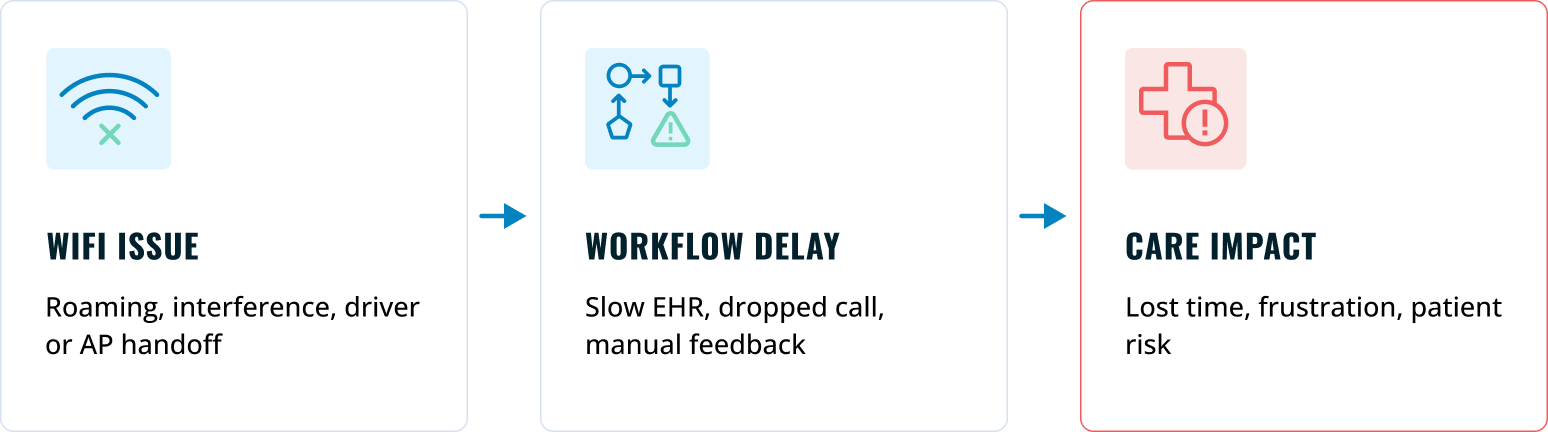
When Wi-Fi Drops, Care Workflows Slow Down
A dropped Wi-Fi connection is never just an inconvenience in a hospital. It can leave a nurse waiting for an EHR to load, interrupt a VoIP handoff between care teams, or disconnect a clinical device during treatment. Even a brief lapse can force clinicians to re-enter credentials or notes, adding thousands of unnecessary interactions across a facility and contributing to frustration and burnout.
Healthcare IT teams are supporting more roaming and connected devices than ever: Workstations on Wheels, VoIP handsets, infusion pumps, patient monitoring equipment, telehealth endpoints, tablets, and mobile nurse carts. Wi-Fi 6 and 6E increase capacity and performance potential, but faster standards and more access points do not automatically guarantee a reliable clinical experience. Continuous, end-to-end visibility is required to understand how devices and connections actually perform from the client perspective.

Workstations on Wheels
WOWs roam constantly between patient rooms, nursing stations, and hallways. Roaming failures, driver issues, and inconsistent access point handoffs create intermittent problems that infrastructure-only tools often miss.

VoIP & Clinical Communication
Voice quality is sensitive to latency, jitter, packet loss, and handoff delays. A momentary interruption can disrupt a care-team conversation at exactly the wrong time.

Infusion Pumps & Clinical IoT
Clinical devices may use older firmware and crowded 2.4 GHz bands. When connectivity is unstable, staff can be forced into manual workflows that increase operational risk.

Patient Monitoring & Telehealth
Real-time alarms, remote sessions, patient engagement tools, and EHR access share the same network. Their reliability depends on understanding the experience beyond the access point.
The cost of poor connectivity
Downtime Is Clinical, Operational, and Financial
Wi-Fi performance affects patient safety, patient satisfaction, clinician efficiency, and the ability of hospital operations to function smoothly. A network can appear healthy in an infrastructure dashboard while users still experience failed roaming, poor voice quality, slow application response, or intermittent disconnections.
Because healthcare interactions are increasingly mediated by connected technology, even small friction points can erode confidence, waste valuable clinical time, and contribute to a poorer patient experience.
Even brief system down times may impact patient care.
- Jamia, 2018
Loss to preventable clinical friction – Nurses spend only about 30% of their time with patients.
Link health IT problems to patient harm – including delays in care delivery.
See what infrastructure tools cannot
Traditional Network Monitoring vs. 7SIGNAL
Most monitoring platforms look from the inside out, relying on access points and controllers to report their own health. 7SIGNAL adds an outside-in view by measuring what end-user devices and the surrounding wireless environment actually experience.
Infrastructure-Only View
Access Point → Controller → Green Dashboard
Answers whether hardware is online. It may not explain why a WOW is roaming poorly, why a VoIP phone drops during handoffs, or why a specific device is slow in one clinical area.
7SIGNAL Client-First View
Clinical Device → Real Experience → Root Cause
Shows device experience, roaming quality, signal behavior, driver performance, latency, packet loss, and other evidence required to diagnose intermittent problems before they become clinical disruptions.
The 7SIGNAL platform
Client, Environmental, and AI-Powered Visibility
Close to 1,000 metrics and KPIs feed EYERIS AI, enabling healthcare IT teams to move from reactive complaint handling to proactive network operations.

7SIGNAL Agents
7SIGNAL Agents run on supported Windows, Android, macOS, Linux, and other endpoint platforms, providing real-time visibility into how devices connect, roam, and perform. Healthcare teams can identify the specific WOW affected by a driver issue, the phone dropping calls during an access point handoff, or the device associating with a suboptimal band—without waiting for a clinician to call the help desk.

7SIGNAL Sensors
7SIGNAL Sensors continuously and independently measure WLAN performance in high-density and high-risk locations such as nursing stations, ICUs, imaging suites, emergency departments, and busy corridors. They expose co-channel interference, signal overlap, coverage gaps, and capacity constraints that can otherwise appear only as vague user complaints.

EYERIS AI
EYERIS AI correlates data across the platform to identify patterns that manual review can miss. It distinguishes among device-level issues, access point problems, driver mismatches, interference, and infrastructure configuration errors—and recommends what to do next.
From symptom to resolution
How EYERIS AI Turns Data into Action
Measure
Client and environment data.
Correlate
Nearly 1,000 metrics and KPIs.
Diagnose
Pinpoint likely root cause.
Recommend
Prescriptive next steps.
Resolve
Use the next steps to quickly resolve your issues
Real-world healthcare results
Northern Kentucky's Largest Healthcare Provider
A Mayo Clinic Care Network member operating five hospitals and more than 116 facilities across Kentucky, Indiana, and Ohio deployed 7SIGNAL to diagnose intermittent connectivity failures that its existing tools could not isolate.
With more than 500 Workstations on Wheels, 500 VoIP phones, and 6,000 access points, the environment had grown beyond what one wireless engineer and a five-person IT department could manually monitor. Nurses and physicians experienced inconsistent WOW connectivity and VoIP call quality, but the events were random, difficult to reproduce, and invisible in existing infrastructure tools.
"Our networking planning and troubleshooting tools weren't able to identify the error, and we didn't have the time or resources to investigate random and elusive issues manually."
— Senior Wireless Engineer, Northern Kentucky Healthcare Provider
From elusive complaints to actionable evidence
7SIGNAL Agents were deployed across Android phones and Windows-based WOWs, providing end-to-end visibility from the device perspective. 7SIGNAL Sensors were installed in high-congestion areas to provide independent WLAN performance data.
The wireless engineer could run daily reports on the worst-performing roaming devices, identify driver-version problems across fleets, pinpoint access points associated with latency, and address coverage gaps before the help desk received a call.
Healthcare Wi-Fi optimization guide
10 Priorities for Healthcare IT Teams
Whether you manage a community hospital or a multi-campus health system, these are the areas where wireless performance has the greatest clinical and operational impact.
- Establish a continuous performance baseline. You cannot optimize what you do not measure. Use real-time monitoring—not only point-in-time site surveys—to understand normal performance and detect deviations before they affect care delivery.
- Monitor WOW roaming performance daily. Track roaming behavior, driver version, access point association quality, and handoff time. Identify underperforming carts before nurses report a problem.
- Validate infusion pump and IoT connectivity. Confirm that clinical IoT devices maintain stable connections, use appropriate bands, and receive sufficient airtime in crowded environments.
- Optimize for voice quality, not throughput alone. Monitor latency, jitter, and packet loss, and correlate call-quality events with roaming behavior and access point handoffs.
- Address co-channel interference proactively. High-density hospital areas and older buildings can suffer from overlapping channels and excessive access point density. Detect and remediate interference before it spreads.
- Standardize driver versions across device fleets. Outdated or inconsistent drivers are a frequent source of roaming and connectivity issues. Use device-level evidence to identify problematic versions and guide standardization.
- Separate clinical and guest traffic rigorously. Clinical systems should not compete with guest and personal traffic. Monitor capacity by SSID and device class and prioritize mission-critical workflows.
- Plan Wi-Fi 6 and 6E migration strategically. Use current performance data to prioritize upgrades where new capacity, channel availability, and lower latency will deliver the greatest operational benefit.
- Build proactive alerting into IT workflows. Alert on roaming failures, signal degradation, device disconnections, latency, DHCP issues, and other leading indicators before the help desk is involved.
- Measure mean time to resolve—and drive it down. Faster diagnosis means faster recovery, less clinical disruption, and more time for strategic work. Use AI-powered diagnostics to compress triage from hours to minutes.
The ROI of healthcare Wi-Fi monitoring
Protect Uptime, Productivity, and Patient Experience
Against the potential cost of downtime, the business case for healthcare Wi-Fi monitoring extends far beyond the networking team. Reliable connectivity affects clinical operations, patient satisfaction, staff productivity, and the hospital's ability to deliver care without unnecessary technology friction.
Less unplanned downtime
Reduction in network-related unplanned downtime.
Hours recovered
End-user productivity hours recovered per year.
Faster resolution
Reduction in time to ticket resolution.
Fewer help desk calls
Through proactive issue detection.
Our customers are patients. We make sure the wireless devices 'touching' a patient are in order.
Principal Network Engineer
Read the Case Study
Healthcare performance improvements
Documented Gains Across Health Systems
Wi-Fi throughput
Improvement at Community Hospital and Wellness Center.
Client throughput
Growth plus a 35% reduction in latency at Akron Children's Hospital.
Downlink throughput
Improvement across Beaumont Hospital locations.
Healthcare Wi-Fi is too important to leave unmonitored
Every Clinical Device Deserves the Same Level of Visibility
The modern hospital is a wireless-first environment. EHRs, clinical communication platforms, medical devices, telehealth systems, and patient engagement tools all depend on reliable Wi-Fi.
7SIGNAL gives healthcare IT teams the visibility to find problems before clinicians feel them, the intelligence to understand root causes faster, and prescriptive guidance to fix them without guesswork. From Workstations on Wheels and VoIP handsets to infusion pumps and patient-monitoring systems, every device can be evaluated through the experience that matters: the end user's.
That level of insight helps healthcare organizations improve network uptime without adding headcount or asking clinicians to become troubleshooting experts. These outcomes span IT, clinical operations, and administration. The ROI is not simply lower IT cost. It is fewer disruptions, faster resolution, better clinician productivity, stronger patient experiences, and a more resilient care environment.
Healthcare Wi-Fi Monitoring FAQ
Healthcare Wi-Fi monitoring continuously measures wireless performance across hospitals and health systems, including the experience of clinical devices such as Workstations on Wheels, VoIP phones, infusion pumps, patient monitors, tablets, and telehealth endpoints. The goal is to detect performance problems before they interfere with care.
Hospital workflows depend on reliable connectivity for EHR access, clinical communication, medical devices, alarms, telehealth, and patient engagement. Even brief interruptions can delay care, interrupt handoffs, increase rework, and reduce clinician productivity.
7SIGNAL Agents run on supported endpoints and measure how devices connect, roam, and perform. 7SIGNAL Sensors independently measure the wireless environment, while EYERIS AI correlates the data to identify root causes and recommend remediation.
Yes. 7SIGNAL can expose roaming failures, driver issues, weak associations, latency, and access point handoff problems affecting Workstations on Wheels, helping healthcare IT teams act before clinicians open a ticket.
EYERIS AI analyzes close to 1,000 metrics and KPIs to detect performance patterns, distinguish among device, driver, access point, interference, and configuration issues, and provide prescriptive guidance for faster resolution.
7SIGNAL complements wireless controllers and infrastructure tools by adding independent client-side and environmental visibility. Infrastructure tools show the health of access points and controllers; 7SIGNAL shows what clinicians and connected devices actually experience.
Healthcare runs on uptime
Protect Care Through Better Network Uptime.
See how 7SIGNAL can help your healthcare organization maintain reliable Wi-Fi for patient safety, clinician productivity, and quality care.
