Manufacturing Downtime Ends Here
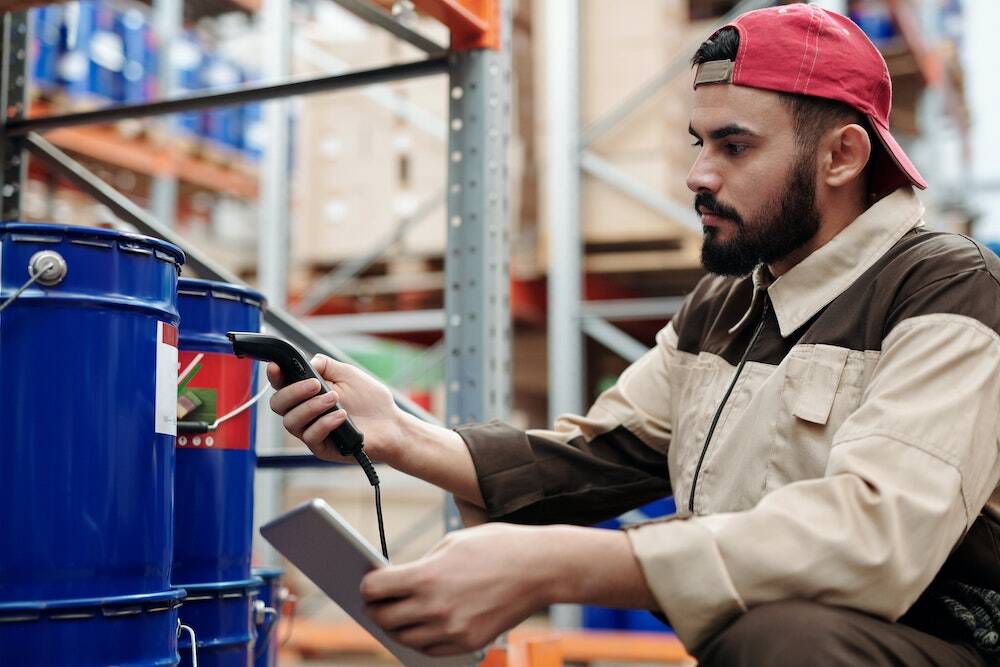
Enterprise Wi-Fi Monitoring Platform for Manufacturing Facilities - Quickly Diagnose and Solve Connectivity Issues
Modern factories run on Wi-Fi connectivity. 7SIGNAL gives industrial IT and OT teams continuous, AI-powered visibility into AGVs, AMRs, scanners, robots, terminals, and more, helping you detect, diagnose, and resolve Wi-Fi problems before they interrupt production.
Independent visibility. See what production devices experience—not just what infrastructure reports.
See the power of 7SIGNAL live in your environment
Stop guessing, resolve issues in minutes, and know for certain if the issue is the WIFI.
Talk to 7SIGNAL~1,000 metrics & KPIs feeding EYERIS AI.
The operational backbone
Wi-Fi Performance Is Now a Production Metric
Industry 4.0 has transformed the shop floor into a Wi-Fi-first environment. AGVs navigate using real-time telemetry. Robots receive instructions over the network. RFID readers, machine vision, environmental sensors, and production systems all depend on stable Wi-Fi.

AGVs & AMRs
Route instructions, low-latency control, and safe handoffs depend on roaming that works continuously across every aisle and production zone.
Scanners & Handhelds
Intermittent disconnects slow pickers and trigger unnecessary device replacement when the actual issue is the network, driver, or access point.
Production Systems
Latency spikes and packet loss can interrupt automated sequences, making a Wi-Fi problem appear to operations as a machine failure.
Industrial IoT
RFID, machine vision, sensors, and connected controllers add load and new failure modes across already complex RF environments.
A uniquely hostile RF environment
Factories Challenge Every Wi-Fi Assumption
High ceilings, steel superstructures, dense racking, forklifts, conveyor machinery, moving inventory, and competing protocols absorb and reflect RF signals in unpredictable ways. Even a well-designed network can develop blind spots as the physical environment changes.
At the same time, workers, vehicles, scanners, and robots are roaming between access points. A connection that drops for a second may be invisible to traditional infrastructure dashboards, yet long enough to stop an AGV or time out a transaction.
7SIGNAL provides independent evidence. It helps determine whether the source of a problem is a device, driver, access point, DHCP service, RF condition, or configuration, before teams replace hardware or interrupt operations.
Zone-level visibility
Every Area Behaves Differently

Loading Dock
Open doors, moving trailers, scanners, and rapid device transitions.

Assembly Line
Dense machinery, repetitive motion, and latency-sensitive production workflows.

Cold Storage
Insulated walls, environmental extremes, and specialized handheld devices.

AS/RS
High racking, autonomous movement, and challenging RF propagation.

Quality Lab
Machine vision, inspection systems, and high-throughput data transfers.

Shift Change
Simultaneous reconnects can expose DHCP and capacity bottlenecks.
The hidden cost
Brief Network Failures Become Production Events
When production stops, losses measured in thousands of dollars per minute pile up fast. Gartner estimates enterprise network downtime at $300,000 per hour, while IDC places critical application failure as high as $500,000 per hour.
In manufacturing, those figures translate directly into idle lines, backed-up material flow, missed shipments, changeover delays, and production attainment shortfalls.
per hour — enterprise network downtime
per hour — critical application failure
per minute — data center downtime
Why traditional tools fall short
Infrastructure Health Is Not Device Experience
An access point can be online while the AGV beneath it experiences a failed handoff, a scanner waits on DHCP, or a production terminal suffers packet loss.
Traditional Infrastructure Monitoring
Access Point → Controller → Dashboard
Confirms that infrastructure is up. Often misses brief roaming failures, client driver problems, DHCP delays, and device-level latency.
7SIGNAL Outside-In Visibility
Production Device → EYERIS AI → Root Cause
Measures the real end-to-end experience and identifies whether the issue is the device, driver, AP, DHCP, RF environment, or configuration.
The 7SIGNAL platform
See the Factory Floor Through Every Connected Device
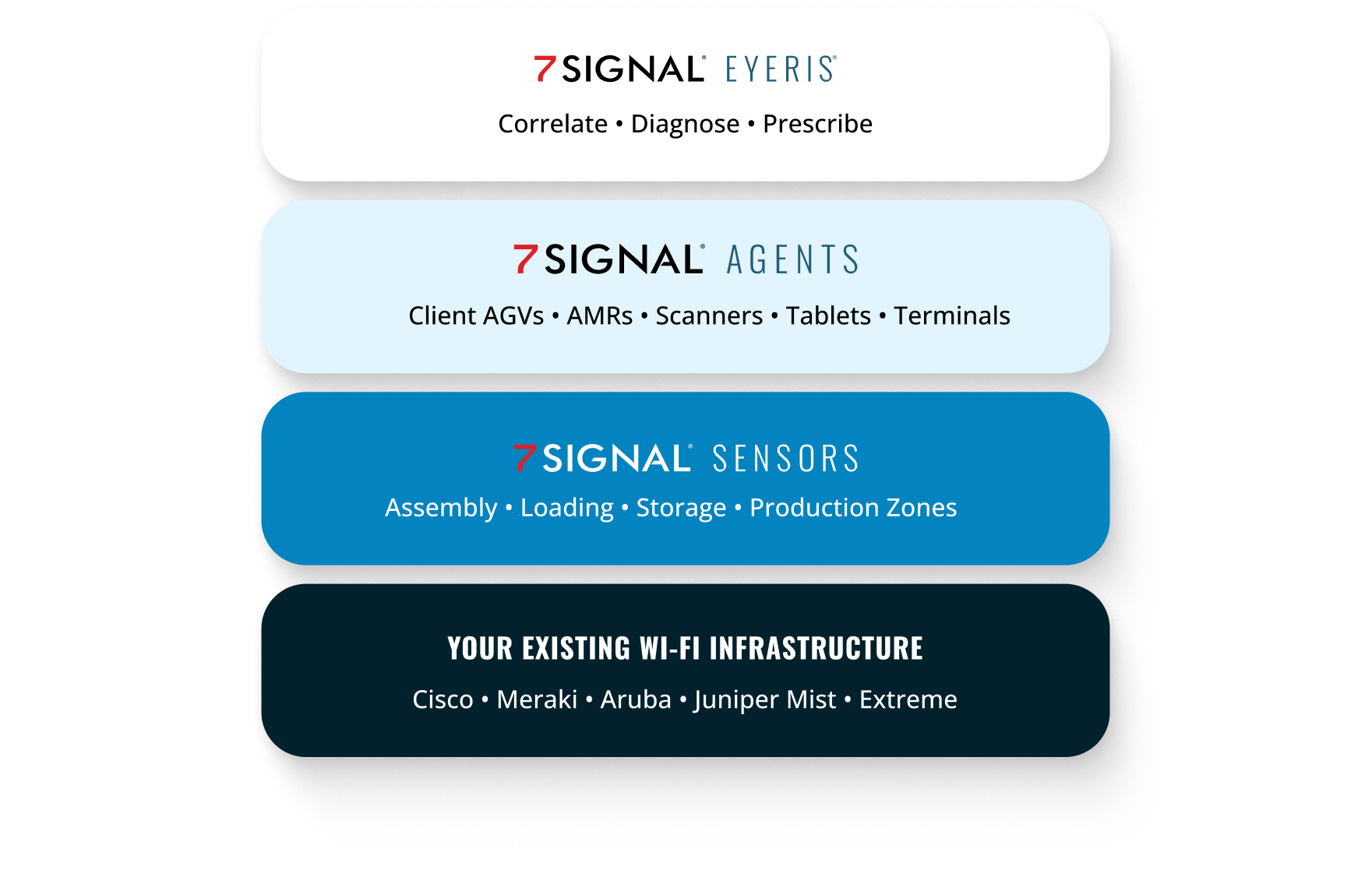
7SIGNAL combines client-side measurements, independent RF sensing, and AI-powered diagnostics. Close to 1,000 metrics and KPIs feed EYERIS AI, which continuously analyzes performance patterns and prescribes specific remediation steps.
7SIGNAL Agents
Deploy on supported Windows, Android, Linux, and other endpoints to show how scanners, AGV controllers, tablets, and production terminals connect, roam, and perform in real time.
7SIGNAL Sensors
Continuously and independently measure WLAN and RF performance in assembly lines, loading docks, automated storage zones, and other high-interference areas.
EYERIS AI
Correlates device, network, and environmental data to distinguish among client, driver, access point, DHCP, interference, and configuration issues—and tells your team what to do next.
From symptom to resolution
AI-Driven Diagnostics Compress Hours into Minutes
Every minute of unexplained Wi-Fi degradation costs money. 7SIGNAL helps manufacturing teams move from reactive firefighting to proactive operations.
Detect
Find roaming, latency, packet loss, and DHCP anomalies.
Correlate
Connect device, RF, infrastructure, and location data.
Diagnose
Identify the real source instead of replacing hardware blindly.
Recommend
Provide prescriptive remediation guidance.
Protect Uptime
Resolve issues before production feels them.
Real-world results
7SIGNAL Found the Problem No Other Tool Could See
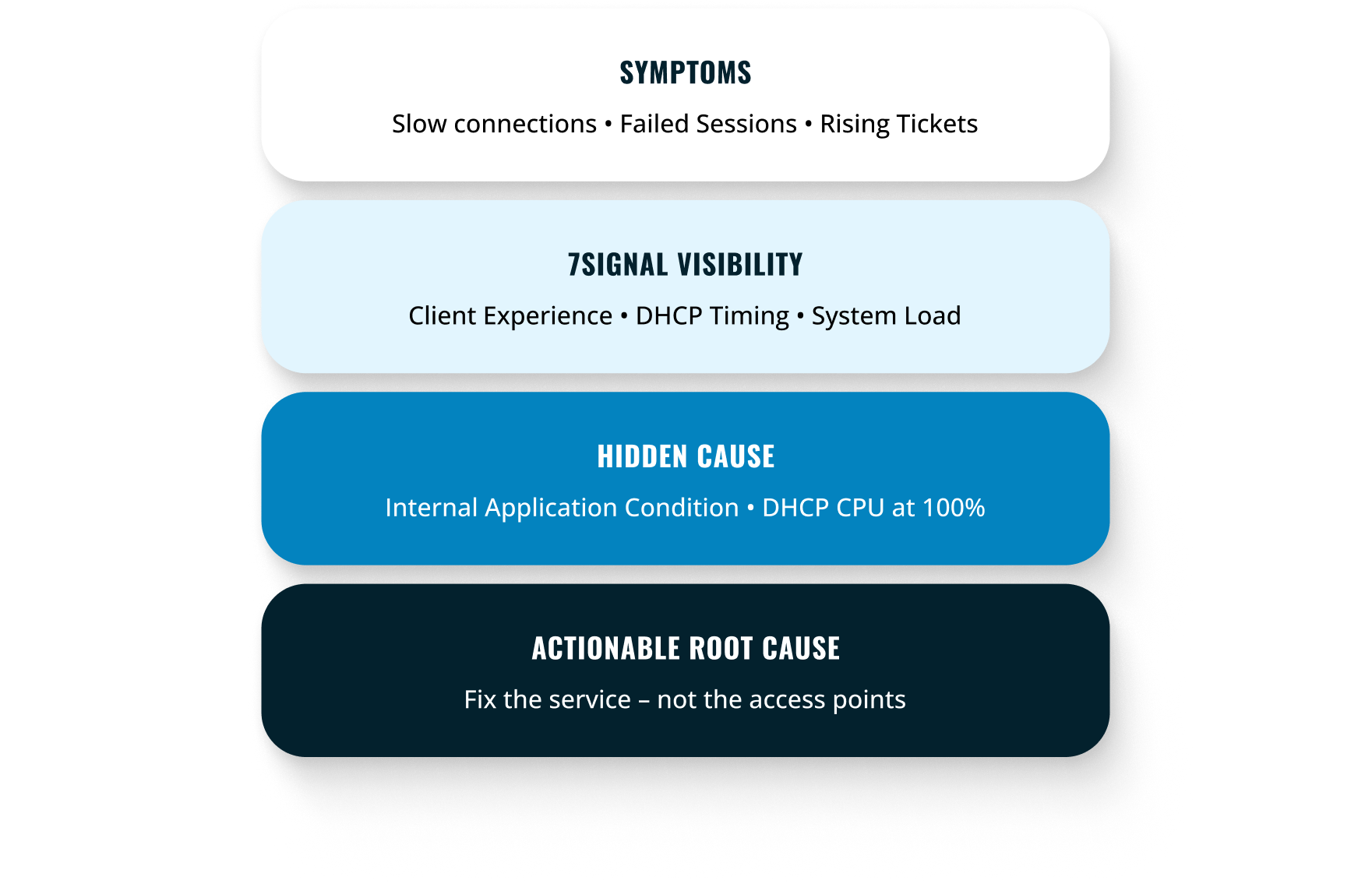
A Fortune 300 materials science leader faced widespread connectivity complaints, rising ticket volume, and hours of manual investigation. Their network management system could not identify the root cause.
After deployment, 7SIGNAL provided end-to-end visibility from the client device outward. The team discovered that an internal software application was reducing system resources through a DHCP configuration condition, pegging CPUs at 100% and causing DHCP offer times to spike.
"7SIGNAL was the only partner to discover the problem."
— Wireless Engineer, Fortune 300 Materials Science Company
Root-cause chain
The WLAN Looked Healthy. The User Experience Was Not.
Measured business outcomes
Protect Throughput, Productivity, and Production Attainment
Manufacturing and distribution customers use 7SIGNAL to reduce downtime, shorten investigation, recover productive hours, and eliminate recurring wireless failures.
Less unplanned downtime
Reduction in network-related unplanned downtime.
Hours recovered
End-user productivity hours recovered per year.
Faster resolution
Reduction in time to ticket resolution.
Fewer help desk calls
Through proactive issue detection.
Recurring AGV roaming failures
Eliminated through route-level monitoring and remediation.
Root-cause visibility
Across device, network, driver, DHCP, and RF conditions.
Continuous measurements
Beyond point-in-time surveys and reactive troubleshooting.
Shared source of truth
For IT, OT, operations, and device teams.
A practical optimization framework
10 Manufacturing Wi-Fi Monitoring Priorities
Focus monitoring on the areas where wireless performance has the greatest impact on throughput, safety, and operational output.
- Monitor AGV and AMR roaming continuously. Track access point handoffs along every operational route. A failure lasting 800 ms can be invisible to infrastructure dashboards and still disrupt autonomous navigation.
- Baseline performance by zone. Compare loading docks, assembly lines, and cold storage against their own normal conditions, not facility-wide avg's that hide problems.
- Validate scanners before replacing hardware. Determine whether an intermittent disconnect is caused by the device, driver, AP, roaming behavior, or network configuration before ordering replacements.
- Track DHCP performance under load. Shift changes and production ramp-ups create simultaneous reconnects. Monitor DHCP offer time to uncover a common but frequently missed source of connection failure.
- Remediate co-channel interference. Steel, racking, and machinery create complex multipath environments. Detect interference before it cascades into reduced throughput or a line interruption.
- Monitor production IoT continuously. Treat sensors, RFID readers, machine vision, and condition-monitoring devices as first-class wireless clients—especially those on older firmware or congested 2.4 GHz bands.
- Standardize drivers across mobile fleets. Use performance data to identify scanner, tablet, and AGV controller driver versions associated with roaming failures and intermittent disconnects.
- Separate operational and corporate traffic. Ensure systems, AGVs, and IoT devices do not compete with laptop/video traffic. Monitor utilization by SSID and device class.
- Correlate Wi-Fi with production KPIs. Make latency, roaming, and capacity events visible alongside OEE, throughput, cycle time, and production attainment to expose operational impact.
- Drive down mean time to resolution. Use AI-powered diagnostics to compress the path from symptom to root cause, freeing engineers for strategic work instead of repeated firefighting.
The ROI of manufacturing Wi-Fi monitoring
Wi-Fi Uptime Protects the Metrics Manufacturing Leaders Already Track
Manufacturing leadership measures success in cycle time, throughput, capacity utilization, production attainment, and on-time delivery. Wireless performance touches every one of those metrics—even when the connection remains hidden until a line slows or stops.
The business case is not simply lower IT cost. It is stronger production continuity, fewer blind spots, better use of engineering time, and a wireless foundation capable of supporting Industry 4.0.

Throughput
Prevent wireless bottlenecks from constraining production flow.

OEE
Connect network events to availability, performance, and quality losses.

Delivery
Reduce delays that ripple into missed shipments and service risk.

Capacity
Make better use of connected assets and automated material movement.

Labor
Recover hours lost to scanner trouble, manual intervention, and investigation.

Scale
Support more automation without adding equivalent monitoring headcount.
Manufacturing Wi-Fi Monitoring FAQ
Manufacturing Wi-Fi monitoring continuously measures wireless performance across factories, warehouses, assembly lines, loading docks, and automated storage environments. It helps IT and OT teams understand what AGVs, AMRs, scanners, robots, production terminals, and industrial IoT devices actually experience.
Modern production depends on continuous wireless connectivity for AGV routing, scanner transactions, machine data, production control, quality systems, and real-time analytics. Even brief degradation can create line delays, manual intervention, missed shipments, and lower production attainment.
7SIGNAL Agents measure device-side roaming, latency, signal quality, DHCP performance, and access point handoffs along operational routes. This exposes brief failures that infrastructure-only dashboards may miss.
7SIGNAL Sensors independently measure RF and WLAN performance in high-interference areas such as assembly lines, loading docks, cold storage, and automated storage zones. They identify coverage gaps, co-channel interference, and capacity bottlenecks.
EYERIS AI analyzes close to 1,000 metrics and KPIs to distinguish among device issues, driver problems, access point faults, DHCP delays, interference, and configuration problems, then provides prescriptive guidance for faster resolution.
No. 7SIGNAL complements infrastructure tools by adding independent client-side and environmental visibility. Controllers report infrastructure health; 7SIGNAL shows what connected production devices actually experience.
Manufacturing runs on uptime
Protect Production Through Better Network Uptime.
See how 7SIGNAL can help your manufacturing operations maintain reliable Wi-Fi for AGVs, scanners, robots, connected equipment, and Industry 4.0 initiatives.
