Identifying and closing gaps in Wi-Fi design and deployments
A conversation with Dennis Holmes, senior advisor for Mobility at Presidio. Presidio is a global digital solutions and services provider delivering software-defined cloud, collaboration and security solutions to customers of all sizes. Presidio designs modern networks for industries ranging from healthcare to manufacturing and retail to sports.
What makes 7SIGNAL’s sensors, agents and AI useful for pinpointing gaps in the design of enterprise networks?
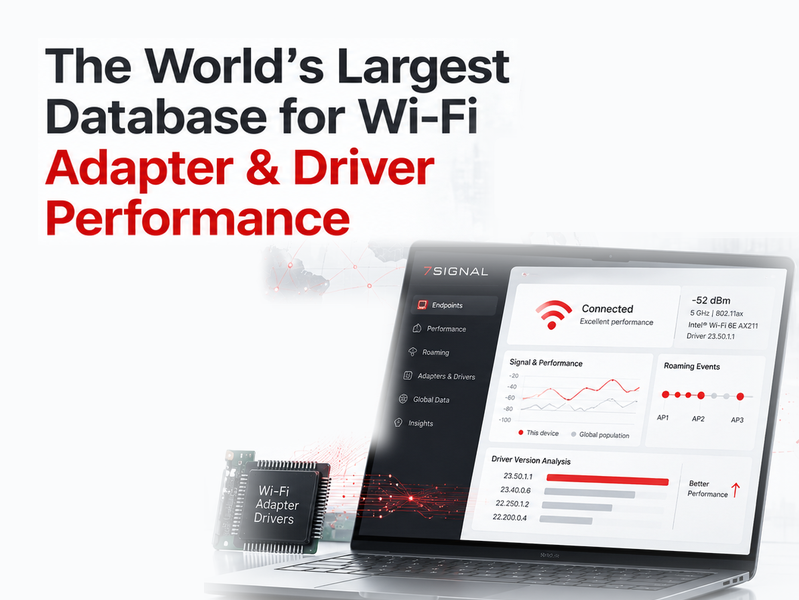
I’ve been in the wireless business since the 1990s, and many vendors claim to do what 7SIGNAL does. But they don’t tie into an agent on the end user’s device. With 7SIGNAL, you get visibility into the end device and device drivers along with a huge database showing which driver works best. That’s the secret sauce. 7SIGNAL shows what devices (and users) experience on the network: roaming behavior, latency, RF interference, and connectivity failures.
Our SAs, or pre-sales guys, help design networks and work with our sales team. 7SIGNAL gives SAs the information they need to develop a better technical strategy and proposal.
What sort of customers or industries benefit from 7SIGNAL’s technology?
At a recent conference, dozens of my customers watched a demo showing how to pick the right device driver. But 7SIGNAL already delivers that very information. From professional sports teams with stadium POS to warehousing companies with handheld devices, customers want to know if the network is operating optimally or quickly pinpoint the problem. 7SIGNAL’s data saves hundreds of thousands of dollars when designing or troubleshooting an enterprise network. That’s the ROI.
Think about an automotive parts maker, which might have a dozen plants. Let’s say one of them makes brake pads and rotors, employs 6,000 people, and its network goes down. They may lose $20,000 per hour while they try to find the problem, fix it, and prevent it from happening again. With 7SIGNAL, as an SA, I can eliminate 90 percent of a customer’s perceived Wi-Fi problems.
I know a couple of warehousing companies that had problems controlling AGVs. They spent hundreds of thousands of dollars trying to figure out the issue. With 7SIGNAL, we figured out there was a radio problem with their AGVs. To fix it, we retrofitted each AGV with a ruggedized wireless access point with an external antenna. That solved the problem on day one with a roaming algorithm.
For sporting venues, 7SIGNAL’s sensors are important in areas that aren’t easily accessible for monitoring such as VIP suites and other revenue-generating areas. 7SIGNAL provides a detailed state of Wi-Fi in case there is an issue with lobbies, merchandise stores, or F&B areas. 7SIGNAL helps show that Wi-Fi is functioning, which is critical for the guest and revenue.
For a hospital or healthcare network, 7SIGNAL’s agents are important because nurses carry devices and use mobile workstations. Infusion pumps and clinical workstations depend on a well-designed and operating network. When Wi-Fi goes down, that interrupts caring for patients. Dropped connections mean healthcare providers have to stop what they’re doing. With 7SIGNAL’s agents, IT staff quickly figure out from the client side what’s going on with the devices or network.
How does 7SIGNAL help a solution architect?
To create and sell a network design to a manufacturing facility, an SA might engage with a plant manager. At a hospital, the SA is selling the chief nursing officer. Neither of these folks care about things like packet loss. So, the SA’s most valuable conversation is about ROI and uptime. To make sure the recommended solution delivers both those things for enterprise clients, the SA wants to know how the design will perform. That’s where 7SIGNAL comes in; it shows the architect what the client experience will be, something the infrastructure dashboard can’t do.
Any final thoughts?
7SIGNAL’s technology has been easy to use. Integrating 7SIGNAL’s solution with AI has made it a lot easier for our team and customers to ask questions in plain language. Network monitoring tools typically show the infrastructure, not what devices experience. Reconciling the two is how an SA can deliver a better proposal for a network design, one that achieves the most uptime. The customer gets a network that requires fewer support tickets and offers a better experience for users.